
Ethics Infinity
|
2025-11-27 14:42:14
With modern customers expecting next-day delivery, even minor hiccups can cause significant inconveniences. Given these circumstances, warehouses cannot function using outdated methods. How manual labor is approached is now more than just inconvenient; it is expensive and dangerous.
Warehouses are not simply storage facilities; to keep up with industry trends, businesses must act quickly and work efficiently. This is what sets them apart from the competition. Smart solutions can aid in warehouse automation, and the implementation of smart solutions is critical in today's fast-paced world.
With tools like automated loading solutions that speed up dispatch, smart conveyor systems that move products with precision, and AI in logistics that helps you plan, automation is changing how warehouses operate. Robotics in warehousing is also helping teams do more with less effort, cutting down on errors and saving time.
In this blog, we’ll explore the latest warehouse automation trends, look at new technologies shaping the industry, and explain why automation is becoming essential for running an efficient and competitive warehouse.
So, let’s break it down and see what’s trending, what’s changing, and what your warehouse should already be doing.
1. The Rise of Automation in Modern Warehousing
Warehouses across industries are increasingly adopting automation to solve critical challenges such as:
- High labor turnover
- Limited space utilization
- Operational inefficiencies
- Manual handling errors
- High throughput requirements
By integrating warehouse automation, companies are achieving faster cycle times, reduced costs, and improved accuracy, all while creating a safer work environment.
2. Key Trends in Warehouse Automation and Loading Equipment
Let’s take a closer look at the transformative trends shaping warehouse operations globally.
A. Robotics in Warehousing
Robotics has moved far beyond experimental use. Today’s robotics in warehousing encompasses a broad range of applications, including:
- Autonomous Mobile Robots (AMRs) for goods movement
- Robotic arms for picking, sorting, and packing
- Automated palletizers and depalletizers
- Goods-to-person systems for efficient order picking
The adoption of robotics leads to enhanced speed, minimized error rates, and improved utilization of vertical space. Integration with warehouse management systems allows for real-time coordination and workflow optimization.
B. Smart Conveyor Systems
Modern smart conveyor systems are intelligent, adaptable, and capable of handling variable loads with precision. Unlike traditional conveyors, these systems can:
- Dynamically route packages based on live data
- Integrate with scanners and weighing units
- Adjust speeds and flow based on demand fluctuations
- Communicate with sorting and labeling modules
These systems not only enhance throughput but also reduce human dependence in repetitive tasks, ensuring consistency and speed during peak operational hours.
C. Automated Loading Solutions
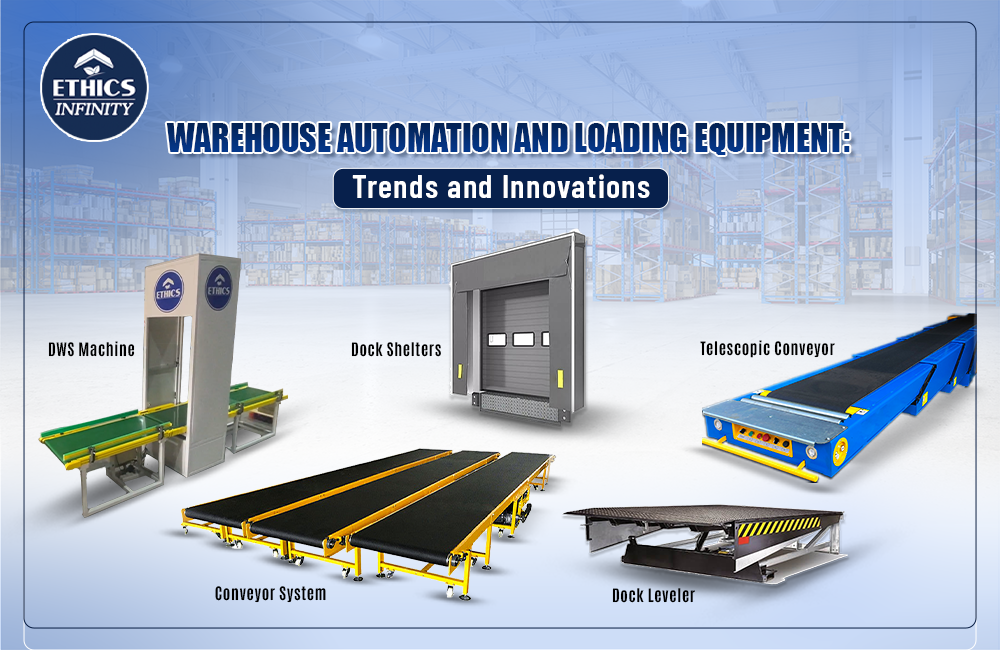
Loading docks are critical to warehouse efficiency, yet often overlooked. Automated loading solutions streamline one of the most labor-intensive processes in warehouse operations. These solutions include:
- Telescopic belt conveyors
- Trailer loading and unloading systems
- Robotic pallet transfer units
- Dock leveling automation
With such systems in place, warehouses can reduce loading and unloading times by up to 60%, minimize labor dependency, and significantly reduce the risk of injury.
D. AI in Logistics
Artificial Intelligence is improving how warehouses function. With AI in logistics, firms can access predictive insights to:
- Inventory forecasting
- Demand planning
- Route optimization
- Equipment maintenance scheduling
- Labor allocation strategies
When combined with machine learning algorithms, AI can continuously improve operational efficiency by learning from historical trends and real-time data.
3. Strategic Advantages of Automation
The adoption of warehouse automation is not just a tactical move; it is a strategic investment with measurable outcomes:
|
Key Area |
Benefit |
|
Labor Efficiency |
Reduces human effort in repetitive and hazardous tasks |
|
Order Accuracy |
Minimizes human error through precision-based automation |
|
Cost Reduction |
Cuts costs related to labor, damaged goods, and mispicks |
|
Scalability |
Easily scalable systems for seasonal or sudden demand shifts |
|
Safety |
Enhances workplace safety by reducing manual handling |
4. Common Implementation Challenges (And How to Overcome Them)
Transitioning to automated systems is a significant shift and comes with its own set of challenges:
a. High Initial Investment
Many businesses hesitate due to capital expenditure. However, considering the long-term savings and ROI, this investment often pays for itself within 18–24 months.
b. Integration with Existing Systems
Legacy systems may not be compatible with modern automation tools. A phased approach with middleware solutions and modular upgrades can bridge the gap.
c. Workforce Adaptation
Automation should not replace workers, but empower them. Proper training and upskilling ensure smooth collaboration between humans and machines.
d. Space Constraints
Optimizing current layouts and leveraging vertical space can create room for automated loading solutions and smart conveyor systems without major structural changes.
5. Future Outlook: Where Are We Headed?
The future of warehouse technology is shaped by convergence, combining AI in logistics, IoT devices, machine learning, and robotics to build fully autonomous, self-optimizing environments.
Emerging innovations include:
- Digital twins of warehouse operations for simulation and planning
- Voice-assisted picking technologies
- 5G-enabled IoT networks for instant communication across devices
- Sustainability-focused automation tools (low-energy robotics, recyclable materials)
6. Getting Started: A Practical Roadmap for Automation
Embarking on your warehouse automation journey doesn’t have to be overwhelming. Start small, measure success, and scale incrementally.
Step-by-step implementation strategy:
- Process Audit: Identify inefficiencies and high-cost areas
- Automation Feasibility Study: Analyze ROI and investment scope
- Technology Selection: Choose scalable, integrable tools
- Pilot Program: Test automation in one section of the facility
- Review & Scale: Analyze results, optimize, and expand
Conclusion
The future of warehousing is not just automated, it’s intelligent, adaptive, and resilient. By adopting cutting-edge warehouse automation trends, such as robotics in warehousing, smart conveyor systems, automated loading solutions, and AI in logistics, businesses can stay ahead of the curve while delivering superior service with lower operational risks.
Warehouses that embrace these innovations today are not just improving efficiency; they are future-proofing their entire supply chain.
Are you ready to transform your warehouse operations with intelligent automation? Let’s design a custom solution for your facility that aligns with your goals, budget, and growth vision. Contact our team to schedule your automation assessment and take the first step toward smarter logistics.